Naegelin CabinYoung · Arizona
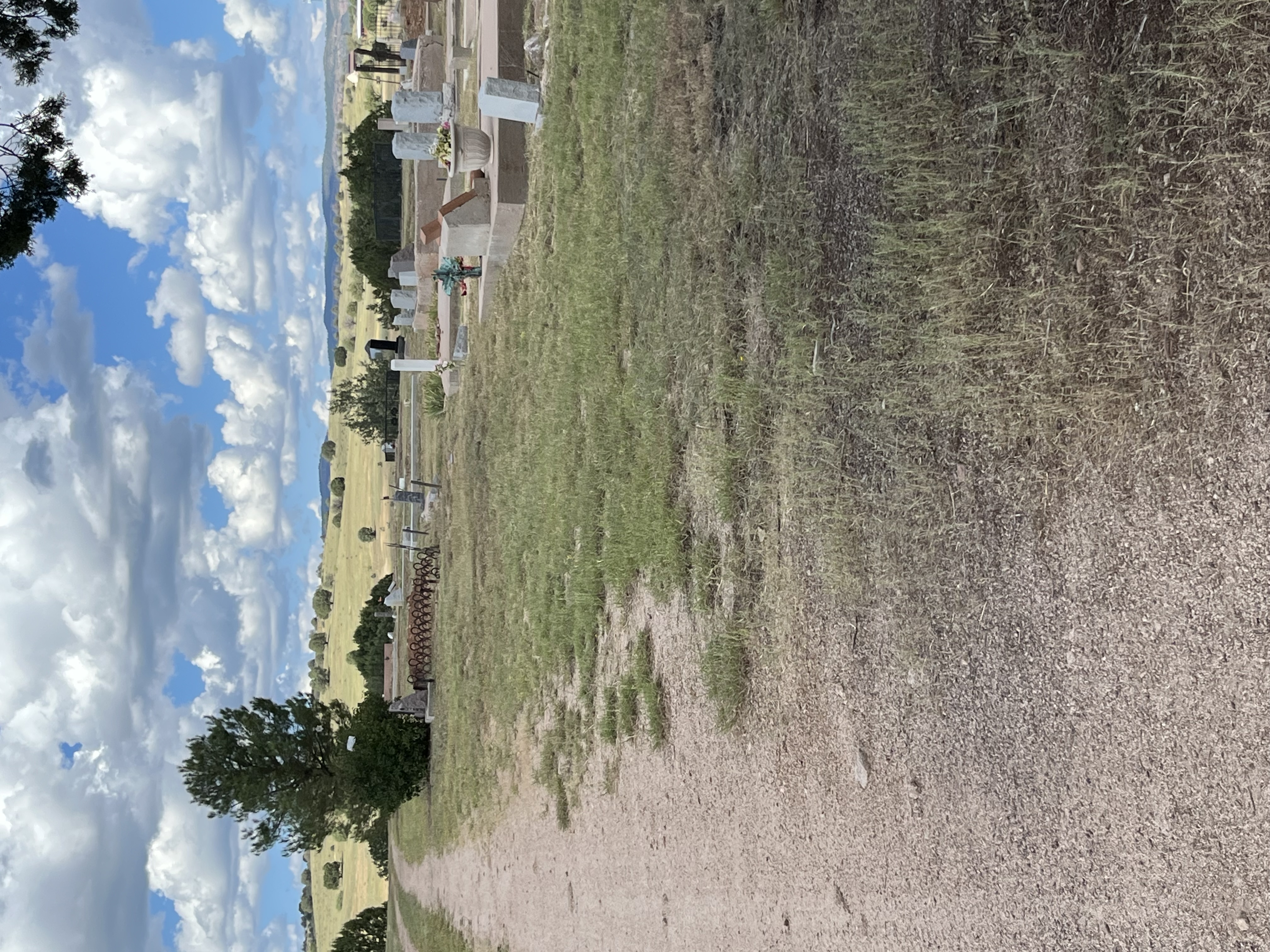
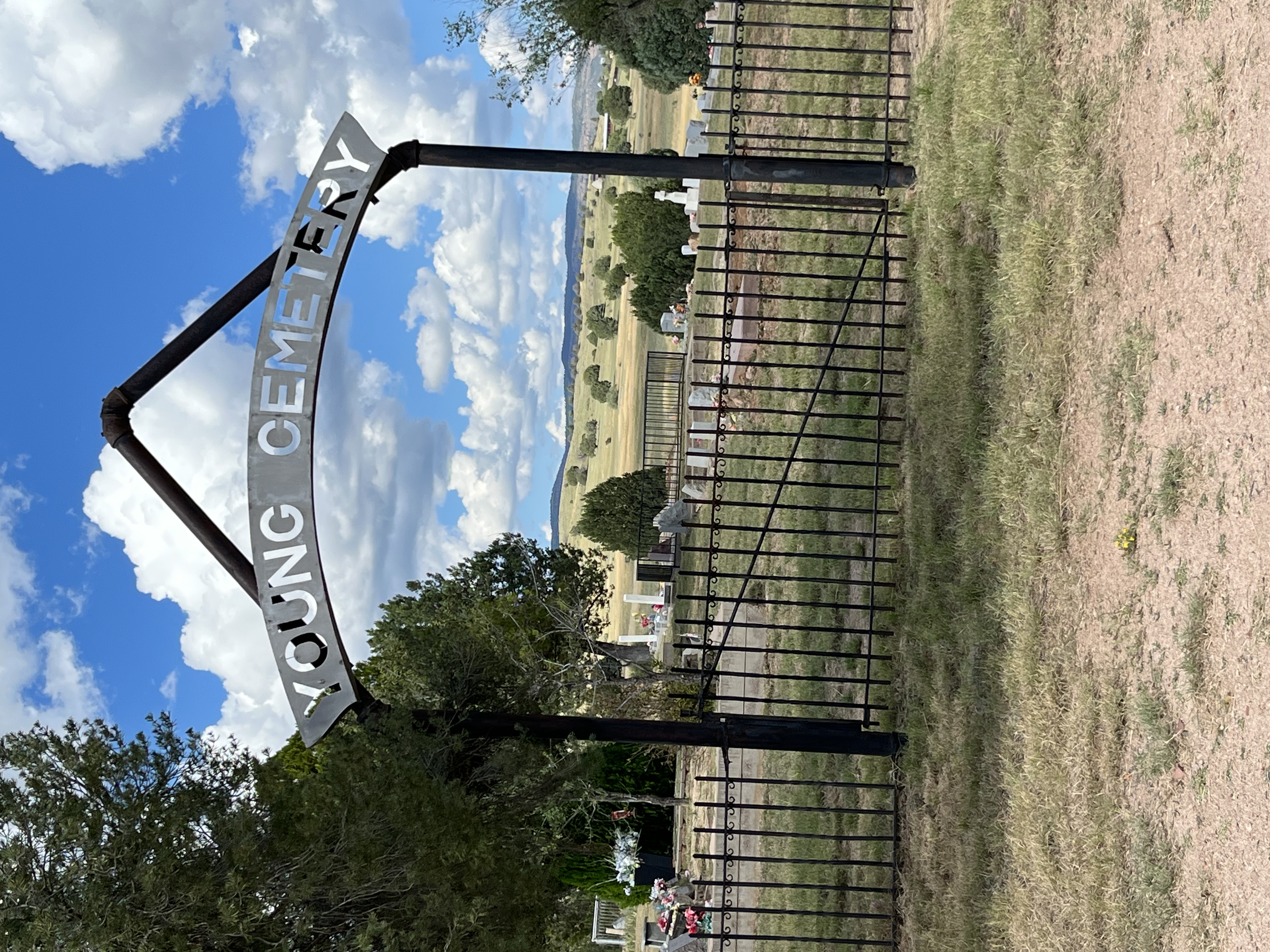
Young Cemetery grounds looking out over Pleasant Valley near Young, Arizona
A short history of a quiet place

Pleasant Valley,
before it was called Young.

Tucked below the Mogollon Rim in Gila County, this basin sits at about 5,100 feet, hemmed in by pine and juniper and reached by a single road that still runs to dirt in stretches. The country looks unhurried today — but the names on the maps and the family plots in the little cemetery carry a heavier story than most visitors expect.

1876
First settlers arrive in Pleasant Valley
1882
The feud begins
1892
Tom Graham killed — the war ends
1919
Louis Naegelin laid to rest here
The Pleasant Valley War

The Tewksbury & Graham feud

Between 1882 and 1892, two neighboring families in this valley — the Tewksburys and the Grahams — killed each other, and most of the men who took sides with them, in a ten-year feud that came to be known as the Pleasant Valley War.

It has been written about in a hundred places since, from Zane Grey's To the Last Man to Don Dedera's careful reconstructions. The short version: nobody won.

1882–1886

Cattle, sheep, and a valley too small for both

The Tewksbury family — John D. Tewksbury Sr. and his sons Ed, John Jr., Jim, and Frank — settled Pleasant Valley in the late 1870s and ran cattle. So did the Graham brothers: Tom, John, and William. What started as a friendship soured over unbranded stock, then broke wide open when the Tewksburys agreed to run Basque sheep for the Daggs Brothers of Flagstaff across the "deadline" the cattlemen had drawn along the Rim.
1887–1888

The killings come one after another

In February 1887, a Navajo herder working for the Tewksburys was shot. That August, a Basque sheepherder working for the Daggs Brothers was killed on the Rim — one of the sparks most often cited for what came next. On September 2, 1887, Graham riders attacked the Middleton cabin where the Tewksburys were staying: John Tewksbury Jr. and William Jacobs were killed in the yard and, by local account, left where they fell for days. Days later, the Perkins store fight at Young left more men dead. Sheriff Commodore Perry Owens's shootout at Holbrook that fall put the feud on the front page of every paper in the Territory.

1889–1892

Two families, all but gone

Vigilance committees, ambushes on the trails, and disappearances thinned both sides through the late 1880s. By 1892 only Tom Graham and Ed Tewksbury were left of the original combatants. On August 2, 1892, Tom Graham was shot from ambush near Tempe while hauling grain; Ed Tewksbury was tried for the killing, and after a hung jury and a mistrial, walked free. He died in Globe in 1904 — the last man standing of what many historians still call the bloodiest range war in American history.

“It was a war fought without generals, without uniforms, without a declared cause anyone could quite agree on — and it emptied the valley of nearly every man old enough to carry a rifle.”
— a commonly cited summary of the feud
The arched gate at Young Cemetery, Pleasant Valley — where most of the men named in this story are buried
The name on the door

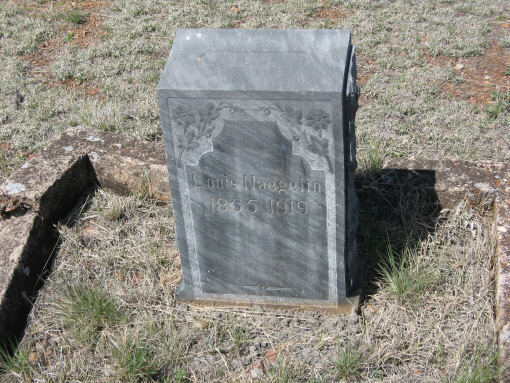
Louis Naegelin1855 – 1919 · Former Hermann boy, later wealthy cattle man

Louis Naegelin's headstone at Young Cemetery, Pleasant Valley — reads Louis Naegelin 1855–1919
His stone at Young Cemetery, Pleasant Valley. The inscription reads simply Louis Naegelin · 1855 – 1919.

Louis Naegelin was born in 1855 at Coles Creek, near the small German river town of Hermann, Missouri — the son of George and Mrs. Naegelin. In 1879, at twenty-four, he left Hermann for the West with a boyhood friend named Joe Faes and a handful of others who wanted the same thing he did: country you could still run cattle on.

He found his first work as a cow-boy in New Mexico, then drifted west across the Rim to Young, Arizona — the same Pleasant Valley the Tewksburys and Grahams were, at that exact moment, tearing to pieces. He worked cattle here through the worst of the feud years and stayed on long after the shooting stopped. Over the decades he built up his own herds, and in the late 1910s sold his interests and retired — in the plain phrasing of his home-town paper — a wealthy man.

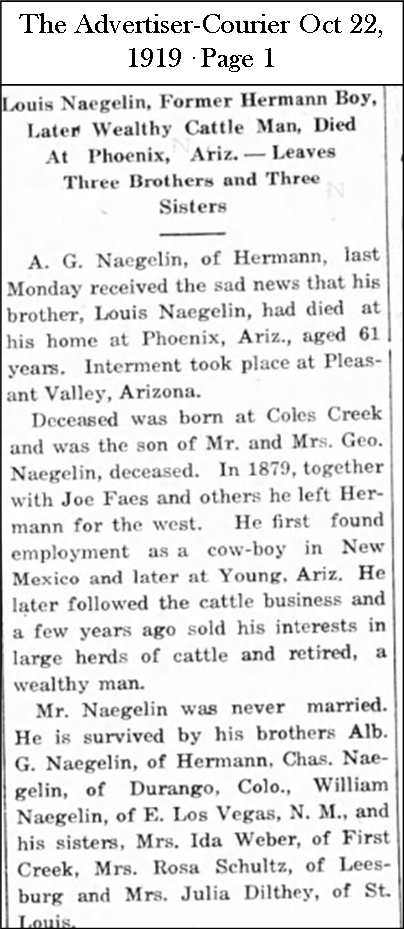
He never married. He died at his home in Phoenix in October 1919, aged 61 by the obituary and 64 by the stone, and was brought back up to the valley for burial. His three brothers — Alb. G. of Hermann, Chas. of Durango, Colorado, and William of East Las Vegas, New Mexico — and his three sisters, Ida Weber, Rosa Schultz, and Julia Dilthey, survived him. What survives him here is his name: on the crossing, and on the little cabin you're staying in tonight.

Obituary of Louis Naegelin as published in The Advertiser-Courier of Hermann, Missouri on October 22, 1919 — headlined 'Former Hermann Boy, Later Wealthy Cattle Man, Died At Phoenix, Ariz.'
Primary source

“Louis Naegelin, Former Hermann Boy, Later Wealthy Cattle Man, Died At Phoenix, Ariz.”

The Advertiser-Courier · Hermann, Missouri
October 22, 1919 · Page 1

Every fact on this page about Louis comes from this notice, run by his hometown paper the week his brother A. G. Naegelin received word from Arizona.

1855
Born, Coles Creek MO
1879
Left Hermann for the West
1919
Buried at Pleasant Valley
an important reminder about life on the Rim

The flag on the ridge.

an honor kept by the community's veterans

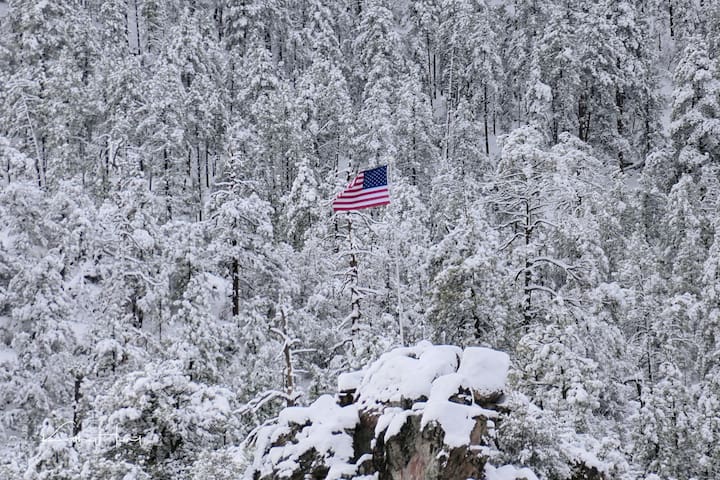
Out on a ridge on the outskirts of the community, wildland firefighters put up a flag while they were training here — and it keeps flying thanks to the efforts of Young's Veterans. In summer it stands against green pine and blue sky; in winter, when the first snow catches on the mountain, it stands against white. It is not marked, and it is not advertised. Once you know it's there, you'll look for it every time you drive that stretch of road.

There is a particular memory evoked by this flag in some people from around here. On June 30, 2013, the Granite Mountain Hotshots — a twenty-person interagency crew based out of Prescott — were overrun by a wind-driven wildfire on a ridge above the little town of Yarnell. Nineteen of them were killed inside their fire shelters. Only their lookout, Brendan McDonough, made it out. It remains the deadliest day for American wildland firefighters since 1933.

The forests around you burn easily. A cigarette out a truck window, a campfire that isn't dead-out, a spark off a chain — this country has lost people to fires that started with less. Treat the woods carefully while you're here. And when you see a hotshot buggy or a helicopter working the Rim in summer, keep in mind who's inside.

19
Granite Mountain Hotshots
Yarnell Hill Fire, June 30, 2013
A tribute flag flying on a snow-covered ridge above the valley — for America's wildland firefighters
The flag on the ridge — visible from the road below

The kettle is always on.

Tell us your dates and we'll say straight away whether they're free.